
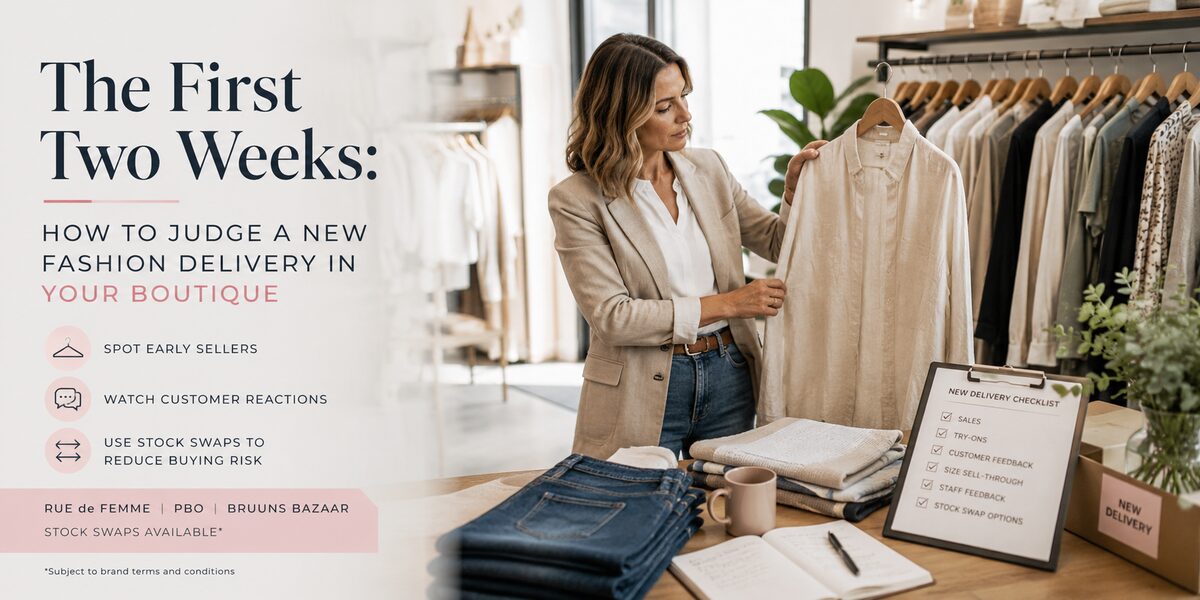
- Don't judge a new delivery on sales alone — try-ons, customer comments and staff reactions can all provide useful early signals.
- Watch which pieces customers repeatedly touch, try on and ask about, even when they don't immediately buy.
- Size sell-through can sometimes tell you more than total unit sales and may help identify potential reorders.
- Give new stock proper visibility before deciding it isn't working.
- Staff feedback matters because they hear the questions and objections that don't appear in a sales report.
- Where available, stock-swap arrangements can reduce some of the risk of buying by allowing slower-moving stock to be exchanged for stronger-selling lines, subject to the individual brand's terms and conditions.
There’s always a little bit of theatre when a new delivery arrives.
Boxes appear. Everything gets unpacked. Someone immediately announces, “That will fly.” Someone else quietly looks at the same piece and isn't quite as convinced.
And within about 48 hours, the garment nobody was particularly sure about has sold twice while the supposed guaranteed bestseller is sitting there looking extremely comfortable with its new surroundings.
Fashion retail does like to keep everyone humble.
Boutique owners know their customers far better than we ever could, so this certainly isn't us attempting to tell anyone how to judge their stock. Instead, we've pulled together a few of the signals that can be useful during those first couple of weeks after a delivery lands.
Some will be completely obvious to experienced retailers. But if there's one idea here that makes you look at a new delivery slightly differently, we'll consider that a decent result.
Don't Look at Sales Alone
Obviously, the till is a fairly useful indicator. If you've received six of something and four disappear in the first weekend, you probably don't need a sophisticated retail analytics system to tell you something is happening.
But sales aren't the only signal. A piece might be:
- picked up repeatedly
- tried on regularly
- getting questions on Instagram
- generating WhatsApp enquiries
- attracting comments from customers
- being recommended frequently by staff
without actually selling particularly quickly.
That's useful information too. The interesting question becomes: Why are people interested but not buying?
It might be price, fit, colour, styling or simply timing. A garment that gets tried on ten times but sells once is telling you something very different from a garment nobody has touched since Tuesday.
Watch What Customers Touch
We've mentioned this in other articles because it's such a simple signal. Customers touch things they're interested in. They pull something out from the rail, check the fabric, look at the price, put it back, walk away, then come back five minutes later and look at it again.
None of that appears as a sale. But it is still customer behaviour worth noticing.
If the same pieces are repeatedly being handled, there may already be demand there that hasn't quite converted. Sometimes the answer is simply better positioning or styling.
Pay Attention to the Fitting Room
The fitting room can tell you an enormous amount about a new delivery. Which pieces are making it in there? More importantly, which pieces are coming back out in shopping bags?
If something is repeatedly being tried but rarely bought, there may be a fit issue. Perhaps customers need to size up. Perhaps the shape looks completely different on the body than it does on the hanger. Perhaps it needs the right trouser underneath it.
That doesn't necessarily mean the piece is wrong. It may simply mean it needs a little more explanation. This is particularly relevant with denim, trousers and newer silhouettes where customers may not immediately know how something is supposed to fit.
Look at Which Sizes Go First
Six units sold sounds useful. But the size breakdown can be even more useful.
If the middle sizes disappear immediately while the sizes at either end remain, that may tell you something about the next order. Similarly, if customers keep asking for a size that's already gone, that's fairly useful evidence that the style itself is working.
It's easy to look at a rail and think, “We still have three of those.” But if the three remaining pieces are all the same size, the picture is slightly different. That information can be particularly valuable when repeat stock is available.
Listen to the Staff
Staff are effectively conducting customer research all day without calling it customer research. They hear:
“I love it, but…”
“Do you have that in another colour?”
“Is there a longer version?”
“Do you have the next size?”
“I'd wear it if…”
“That's gorgeous.”
And occasionally the devastating:
“No.”
That feedback is useful. A quick conversation with the team after the first weekend can often reveal patterns that aren't obvious from the sales figures. What are customers asking for? What's getting tried? What's getting compliments? What are staff naturally recommending? And what are they avoiding showing customers?
Give the Delivery a Fair Chance
There is one important caveat to judging those first two weeks. The stock has to actually be seen.
A beautiful blouse squeezed between twelve other garments at the back of a rail hasn't necessarily failed a commercial test. It may simply have failed a visibility test.
Before deciding something isn't working, it can be worth trying:
- moving it to another rail
- putting it in the window
- styling it as part of a complete outfit
- showing it on Instagram
- trying it on a member of staff
- sending it to a customer who might genuinely like it
- pairing it with an existing bestseller
Sometimes moving one piece three metres across the shop can produce a completely different result. Retail is wonderfully scientific like that.
Show Customers How to Wear It
Some clothes explain themselves. Others need a little help.
This becomes particularly relevant when a collection introduces a newer silhouette, different proportion or unusual colour combination. A customer might walk past something on the hanger but love it once she sees it worn.
That's where a quick try-on video can be useful. Nothing elaborate. No lighting crew required. Nobody needs to hire Steven Spielberg. Simply show how it fits, how the fabric moves, what you'd wear with it and where it sits on the body.
That can sometimes be enough to turn an overlooked piece into something customers suddenly understand.
For more practical ideas, see our guide to Instagram content for fashion boutiques.
Don't Forget What It Works With
New stock doesn't have to live exclusively with the rest of its delivery. Sometimes the best way to sell something new is to put it beside something customers already understand: a new blouse beside a proven trouser, a jacket over a bestselling dress shape, or a new knit with familiar denim.
That can help customers picture the garment as part of their existing wardrobe rather than as an isolated purchase. And if they already own the trouser or jeans? Even better.
Our guide on how to merchandise your fashion boutique covers more ways to use positioning and styling to help stock sell.
Reorder the Winners While They're Still Winners
One of the most useful things those first couple of weeks can reveal is what may be worth repeating.
If a style is clearly moving and repeat stock is available, acting early can make sense. The important part is distinguishing between “We sold one” and “We've sold several, customers are asking for more sizes, staff keep recommending it and another customer messaged about it this morning.”
The second scenario is considerably more interesting.
Of course, repeat availability varies by brand and collection. But when it is available, those early signals can help boutiques react while demand is still there. This is part of how you can identify your bestselling fashion pieces and reduce markdown risk.
And What About the Pieces That Aren't Moving?
This is where things get interesting. Every buyer gets something wrong occasionally. We certainly wouldn't trust anyone who claimed otherwise.
A style looked fantastic in the showroom. Everyone loved it. It arrived. And customers collectively decided they'd rather admire something else.
Normally, that leaves the retailer with a choice between waiting, trying to merchandise it differently or eventually marking it down. But some brands offer another option.
Stock Swaps Can Take Some of the Risk Out of Buying
This is worth knowing because it isn't available with every fashion brand. Some suppliers operate stock-swap arrangements.
In simple terms, if an agreed line is genuinely slow-moving, there may be an opportunity to return eligible stock and replace it with another line that is selling more strongly.
Those conditions matter. Stock swaps aren't an unlimited facility to send back anything that hasn't sold by Friday afternoon. Eligibility, timing, stock condition, availability of replacement products and other requirements can vary between brands and collections.
So boutiques should always check the applicable terms with us first.
But used properly, it is a very useful facility. For the boutique, it can reduce some of the risk involved in trying a collection or buying into a particular style. For the brand, it helps get the right product into the right stores.
Stock Swaps Also Change How You Can Think About the First Two Weeks
This is another reason early observation matters. If a brand offers a stock-swap facility, spotting genuinely slow lines sooner gives everyone more information to work with.
That doesn't mean panicking because something hasn't sold in three days. Quite the opposite. The first couple of weeks give you an opportunity to see whether a style is getting attention, being tried on, selling through certain sizes, needing better merchandising, benefiting from being shown online, simply needing more time, or genuinely appearing to be the wrong product for your customer.
If you've tried the obvious things and the stock still isn't working, that's when knowing a stock-swap facility exists can become valuable.
Keep a Very Simple Scorecard
This doesn't need to become another administrative job. Nobody opened a boutique because they had an overwhelming desire to create more spreadsheets.
A simple mental or written check after the first week or two could be enough:
- Selling quickly: potential reorder.
- Getting lots of interest but few sales: investigate why.
- Selling in particular sizes: check the size curve.
- Not being noticed: move it or show it differently.
- Being tried but not bought: check fit, price or styling.
- Genuinely not working: check whether a stock swap or another solution may be available.
That's probably enough information to make the next decision.
The First Two Weeks Aren't the Final Verdict
This may be the most important point. Not every style reveals itself immediately.
Weather changes. Customers' wardrobes change. Payday arrives. Something appears on Instagram. A staff member finally tries it on. Suddenly the piece that's been sitting quietly for ten days starts moving.
So the first two weeks shouldn't necessarily be treated as a pass-or-fail examination. Think of them more as an early warning system. They provide clues. The job is working out what those clues are telling you.
Final Thought
Boutique owners already have something no report, spreadsheet or article can replace: knowledge of their own customers.
You know what gets picked up. You know what gets tried on. You know what comes back out of the fitting room. And you know when something just isn't working.
The useful part is combining those instincts with the little signals appearing during the first couple of weeks: sales, sizes, try-ons, questions, staff feedback, social reactions and, where available, facilities such as stock swaps.
Nobody gets every buy right. If someone tells you they do, we'd probably ask to see the stockroom.
The aim isn't perfection. It's spotting what's working early enough to do more of it — and spotting what isn't early enough to do something about it.
Elevation Agencies works with independent fashion boutiques across Ireland from our showroom at Fashion City, Dublin. We represent Rue de Femme, PBO, Bruuns Bazaar, Black Colour, Yoga Jeans and Yumi London, and distribute OTRA Eyewear. Stock-swap arrangements are available from selected brands including Rue de Femme, Bruuns Bazaar and PBO, subject to the individual brand's applicable terms and conditions. Contact us for current information on availability, repeat orders or stock-swap options.
Frequently Asked Questions
- How long should a boutique give a new fashion delivery before judging it?
- There is no fixed period that applies to every collection, but the first one to two weeks can provide useful early signals. Boutiques can look at sales, customer try-ons, size sell-through, enquiries, staff feedback and how customers interact with the product before drawing conclusions.
- How can a boutique identify a potential bestseller?
- Strong early sales are the clearest sign, but repeated try-ons, customer enquiries, requests for sold-out sizes, staff recommendations and social-media responses can also indicate that a style has strong potential.
- What should a boutique do if a new style isn't selling?
- Before writing it off, consider changing its position, styling it with a proven seller, showing it on a person, featuring it on social media or asking staff what feedback they are hearing. If it remains slow, check whether repeat, exchange or stock-swap options are available from the supplier.
- What is a fashion stock swap?
- A stock swap is an arrangement offered by some fashion brands that may allow eligible slower-moving stock to be returned and replaced with stronger-selling product. The exact conditions vary by brand and are subject to the supplier's applicable terms and stock availability.
- Which Elevation Agencies brands offer stock swaps?
- Rue de Femme, Bruuns Bazaar and PBO currently offer stock-swap arrangements through Elevation Agencies, subject to each brand's individual terms and conditions. Boutiques should contact Elevation Agencies to confirm the current conditions and eligibility before arranging a swap.
- Do stock swaps reduce the risk of buying a new fashion brand?
- They can help reduce some inventory risk because eligible slower-moving stock may be exchangeable for stronger-performing lines. However, stock swaps are subject to individual brand terms and should not be treated as an unconditional return facility.
What If You Get the Buy Wrong?
Talk to Elevation Agencies about current availability, repeat orders and whether stock-swap options may apply to an eligible line.
Get in TouchBook a Brand Appointment
Want to discuss what might suit your boutique? Request a short brand appointment with Elevation Agencies.
Request an Appointment