
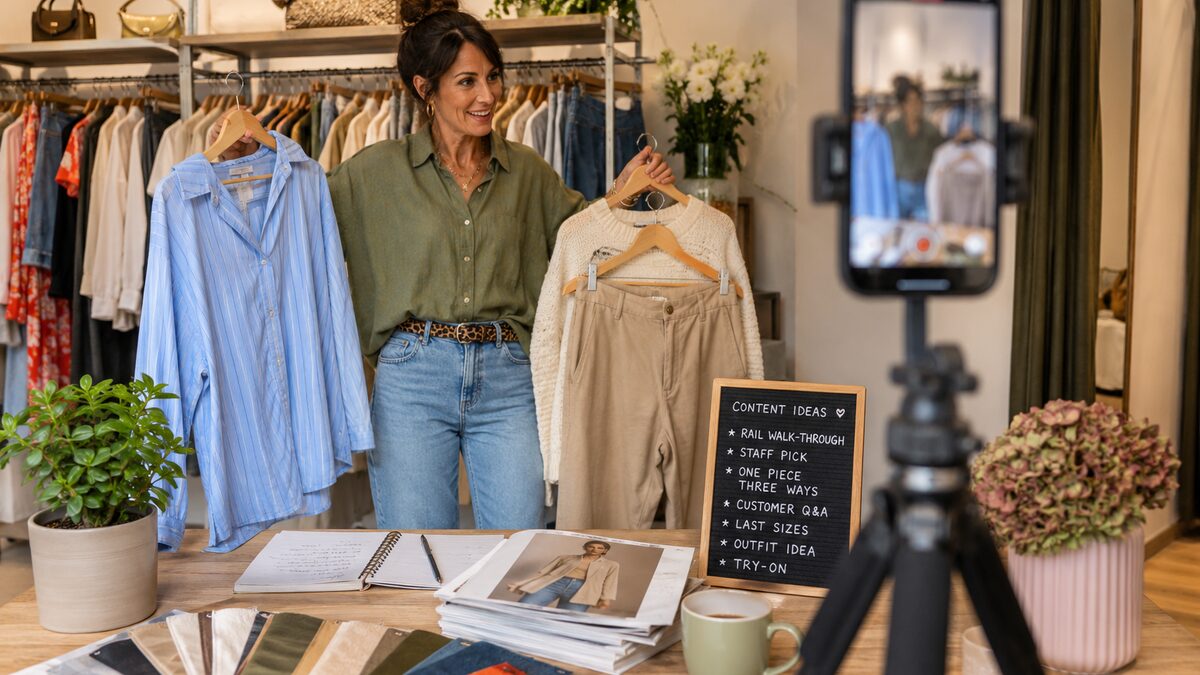
- A rail walk-through with a short caption reminds customers what is available and is one of the easiest posts to create.
- Staff picks work because they feel human — a genuine explanation from someone in the shop is more useful than a polished description.
- Showing one piece three ways gives customers outfit ideas and produces three pieces of content from a single item.
- Answering common customer questions publicly removes small buying barriers for people who are watching but not yet asking.
- Try-on videos do not need to be perfect — clear fit information and available sizes are what customers actually need.
- A simple weekly content routine covering rail walk-throughs, staff picks, try-ons and outfit ideas is enough to stay visible during quieter weeks.
Every independent boutique has quiet weeks.
Sometimes it is the weather. Sometimes it is the time of month. Sometimes everyone seems to be watching stories, liking nothing, buying nothing, and generally making Instagram feel like you are shouting into a stylish but silent void.
It happens.
A quiet week does not mean your stock is wrong, your buying was wrong, or that Instagram has personally turned against you — although some days it can feel like it has. Customers may still be looking. They may be waiting for payday, thinking about holidays, distracted by school runs, or simply not in buying mode that day.
That is where Instagram can still do a useful job. The aim is not to panic-post, discount everything, or suddenly become a full-time content creator with a ring light, a tripod, and a minor identity crisis. The aim is simpler: keep showing the stock clearly, give customers useful outfit ideas, and make it easy for someone to message, visit, or buy when they are ready.
Here are a few practical Instagram ideas boutiques can use when sales are quiet.
Do a Quick Rail Walk-Through
This is probably the easiest place to start.
No need for dramatic music, seven transitions, slow-motion hanger shots, and a cinematic opening sequence. A simple rail walk-through can work perfectly well if the customer can actually see what is available.
The key is to add a little bit of context. Instead of silently filming the rail and hoping people understand what they are looking at, say something useful:
- "A few easy pieces still available this week"
- "Light layers for cooler summer days"
- "New-season neutrals beside final summer pieces"
- "Pieces that work for lunch, work or weekends"
- "A quick look at what is still available in sizes 10–16"
A rail walk-through reminds people what is in the shop. Customers forget. They may have seen a piece once, liked it, and then got distracted by life, dinner, a match, a child needing a lift, or twenty-seven WhatsApp messages. Showing it again is not annoying. It is often necessary. Half of retail is politely reminding people that the nice thing they liked is still sitting there.
Pick One Piece You Actually Like
Staff picks work because they feel human. Customers like knowing what someone in the shop genuinely likes. It does not have to be a big sales pitch. Sometimes a simple explanation is far more useful than a polished product description written by someone who has clearly never stood in a fitting room queue on a Saturday.
For example:
"Our favourite piece on the rail today — easy to wear, lovely shape, and not too dressy."
Or:
"Mary's pick this week: this light jacket because it works over dresses now and with jeans later."
This kind of post works especially well for pieces that are good but not getting enough attention. Some stock just needs someone to explain it properly. Every boutique has had that item that looks a bit "grand" on the hanger and then suddenly looks brilliant on a real person. Those pieces need help. Give them their moment.
Show One Piece Three Ways
"One piece, three ways" is one of the best boutique formats because it does not require new stock, a big plan, or a marketing department hiding upstairs with mood boards. You take one piece and show customers how it could fit into different parts of their life.
A shirt could be shown:
- tucked into jeans for daytime
- worn open over a vest for holidays
- styled under a blazer for work
A dress could be shown:
- with sandals for summer
- with trainers for casual wear
- with boots and a jacket for later in the year
This works because customers often need help imagining the item away from the rail. If a customer can see three ways to wear something, it feels more useful. And useful pieces are easier to buy. It also gives you three pieces of content from one item, which is the sort of small miracle boutique owners deserve.
Turn Customer Questions Into Posts
Boutiques answer useful questions all day long. The problem is that the answer often disappears after one conversation. Instagram gives you a way to turn those everyday questions into content.
Good examples include:
- "What can I wear over this dress?"
- "Is this true to size?"
- "Could I wear this to work?"
- "Is this too dressy for daytime?"
- "What shoes would work with this?"
- "Can this be worn into autumn?"
Each one could become a short post, story, reel or caption. This is helpful because lots of customers have the same doubts. They may not ask, but they are wondering. If you answer the question publicly, you remove a small buying barrier for everyone watching.
Re-Show Pieces That Did Not Get Enough Attention
Not every slow seller is a bad buy. Sometimes a good piece has simply not had its moment yet. Before moving it to the back rail or sending it sadly towards the sale section, it may be worth giving it another chance.
Ask:
- Has it been tried on?
- Has it been styled into an outfit?
- Has it been shown in natural light?
- Has the fit been explained?
- Has it been placed beside the right pieces?
A dress that looks flat on the hanger might look much better worn. A shirt that seems plain might make complete sense once styled with denim. Sometimes the stock is fine. The story around it just needs to be clearer.
Use "Last Sizes" When It Is Genuine
If stock is genuinely limited, last-size posts can work well. They give customers useful information and create natural urgency without making the post feel pushy.
Examples:
- "Last one left in size 12"
- "Only sizes 10 and 14 remaining"
- "Final two available"
- "Last chance on this colour"
The important part is to keep it honest and specific. A simple post could say:
"Final size 12 left in this dress. Lovely one for holidays or lunch out. Message us if you would like it held."
That is clear, helpful and easy to act on.
Create a "Worth Another Look" Post
A "worth another look" post is useful when you have strong pieces that customers may have missed. It gives you a reason to show stock again without pretending it is new.
You could post:
- "Three pieces worth another look this week"
- "A few styles we think are stronger on than on the hanger"
- "Quiet favourites from the rail"
- "Easy wardrobe pieces still available"
Not every post has to be about something new. Sometimes the best sales come from showing existing pieces more clearly, especially when customers are busy or scrolling quickly.
Show Outfits for Real Customer Situations
Customers often shop for situations, not categories. They may not be thinking, "I need a blouse." They may be thinking, "I have lunch on Saturday and nothing feels right." That is where outfit posts can work well.
Try posting around real-life moments:
- lunch with friends
- family event
- weekend away
- dinner out
- work meeting
- holiday travel
- match day
- school event
- something smart but not too dressy
A practical caption could be: "An easy outfit for lunch or a day out — comfortable trousers, light blouse, and a jacket if the weather turns." This feels helpful because it solves a small problem. And in Ireland, "if the weather turns" is never a bad line to include.
Try It On, Even If It Is Not Perfect
Try-on videos are useful because customers want to see how clothes move on a real person. The video does not need to be perfect. In fact, it probably feels more believable if it is not. Good lighting helps, but nobody needs a Hollywood production. A mirror, a phone and a clear explanation are usually enough.
A useful try-on might include:
- size being worn
- available sizes
- fit note
- price
- how to style it
- how to buy or hold
For example: "Trying on three easy pieces still available this week. I'm wearing size 12 in the dress; it is a generous fit, and we have sizes 10, 12 and 14 left." Try-on videos are especially good during quiet weeks because they bring energy back to the stock. Most customers care more about seeing the fit than whether the lighting has been approved by Vogue.
Create New Outfits From Existing Stock
If there is no new delivery, create newness by combining existing pieces differently. A customer may have seen each item separately, but not together.
Try:
- older blazer + newer blouse
- sale trousers + full-price knit
- dress + denim jacket
- shirt + scarf + sunglasses
- neutral basics + one strong colour
A caption could say: "No new delivery today — just a new outfit idea from pieces already on the rail." That sort of honesty can actually work well. Customers know how shops work. Not every Tuesday can be a major fashion event. Sometimes Tuesday is just "we put this jacket with these trousers and it works."
Use Polls and Questions in Stories
Instagram Stories are useful during quiet weeks because they allow small, easy interaction. Not every customer is ready to buy, but they may still answer a quick poll.
Try:
- "Would you wear this with jeans or trousers?"
- "Which colour would you choose?"
- "Dress it up or keep it casual?"
- "Would you like a try-on of this?"
- "Should we style this one three ways?"
These small interactions keep the account active and give you feedback. They also help customers feel involved, even if they are not buying that day. Sometimes a person who will not reply to a message will happily vote in a poll about beige versus navy. Use what works.
Remind People You Can Actually Help
This is where independent boutiques have a real advantage over the big retailers. A website cannot say, "I think the green would suit you better than the beige." A boutique can.
Posts can mention:
- outfit advice
- size checks
- holding items until closing
- WhatsApp photos
- posting items out
- styling help for occasions
- honest fit advice
A simple post could say: "Not sure what to wear with something? Message us a photo and we will suggest a few pieces from the rail." That is the kind of service big retailers struggle to copy. The algorithm may be powerful, but it still cannot remember that a customer hates sleeves that cling. A good boutique can.
Use WhatsApp Carefully
WhatsApp can be very effective during quieter sales periods, especially when used personally. The key word is personally. A general broadcast has its place, but a thoughtful message to the right customer can be much stronger.
For example:
"Hi Anne, we still have the trousers you liked in your size, and we styled them today with the cream blouse. I can send a photo if you like."
Or:
"This dress came back into your size and I thought of you because you asked for something for holidays."
That feels like service rather than pressure. Independent boutiques know their customers. That is a major advantage. Use it carefully and respectfully.
Create a Simple Weekly Content Routine
When sales are quiet, a routine helps. You do not need to reinvent Instagram every morning while also opening boxes, answering messages, steaming stock and wondering why the coffee has gone cold again.
A simple week could look like this:
- Monday: Rail walk-through — show what is available and mention key categories.
- Tuesday: Staff pick — choose one piece and explain why you like it.
- Wednesday: One piece, three ways — style one item in three different outfits.
- Thursday: Customer question — answer a question you get regularly in-store.
- Friday: Weekend outfit — create an outfit for lunch, dinner, travel, matches or family plans.
- Saturday: Try-on video — show fit and available sizes.
- Sunday: Worth another look — re-show two or three strong pieces customers may have missed.
That is enough structure to keep posting without overthinking it. And if you miss a day, nothing explodes. Instagram will survive. So will the rail.
Final Thought
Quiet sales periods are normal in boutique retail. The answer is not always to discount, panic or wait for the next delivery. Sometimes the best move is simply to show the stock in a clearer, more useful way.
Instagram works best when it helps the customer imagine the piece in her own life. That could mean a try-on video, a staff pick, a last-size reminder, a rail walk-through, or a simple outfit idea.
None of this needs to be complicated. Most boutique content that works is fairly simple:
- show the piece clearly
- explain why it is useful
- say what sizes are available
- make it easy for the customer to ask a question
If the post is helpful, clear and a bit human, it is already doing more than most. And if all else fails, try the garment on. Clothes are nearly always more convincing on a person than on a hanger looking vaguely offended.
For boutiques stocking womenswear through Irish agencies, brands like Rue de Femme, PBO, and Black Colour offer pieces that tend to photograph and film well — making Instagram content easier to create consistently. Read more about what Irish boutiques look for in a new brand or browse more retail tips on the blog.
Elevation Agencies supports Irish boutiques with selected womenswear and accessories brands through our Fashion City, Dublin showroom and direct trade communication.
Frequently Asked Questions
- What should a boutique post on Instagram when sales are quiet?
- A boutique can post simple, useful content such as rail walk-throughs, staff picks, one piece styled three ways, try-on videos, last-size reminders, customer questions and outfit ideas for real-life occasions.
- Do boutiques need new stock to post on Instagram?
- No. Boutiques can create fresh content by restyling existing stock, showing pieces in new outfit combinations, answering customer questions or highlighting items that are worth another look.
- Are try-on videos useful for boutique Instagram content?
- Yes. Try-on videos help customers see fit, length, movement and styling ideas. They do not need to be perfect; a clear video with useful size and fit information is often enough.
- How often should a boutique post during quiet sales weeks?
- A simple routine of a few posts or stories per week can work well. Boutiques can rotate between rail walk-throughs, staff picks, customer questions, weekend outfits and try-on videos.
- How can a boutique make Instagram posts feel less salesy?
- Boutiques can make posts feel less salesy by being helpful and specific: explain why a piece works, show how to style it, mention available sizes, and invite customers to ask questions.
Looking for Brands That Work on Rail and Online?
Elevation Agencies represents selected womenswear brands — Rue de Femme, PBO, Black Colour, OTRA Eyewear, Yoga Jeans and Bruuns Bazaar — through our Fashion City, Dublin showroom. Get in touch to discuss brands that suit your boutique and your customers.
Get in TouchBook a Brand Appointment
Want to discuss what might suit your boutique? Request a short brand appointment with Elevation Agencies.
Request an Appointment