
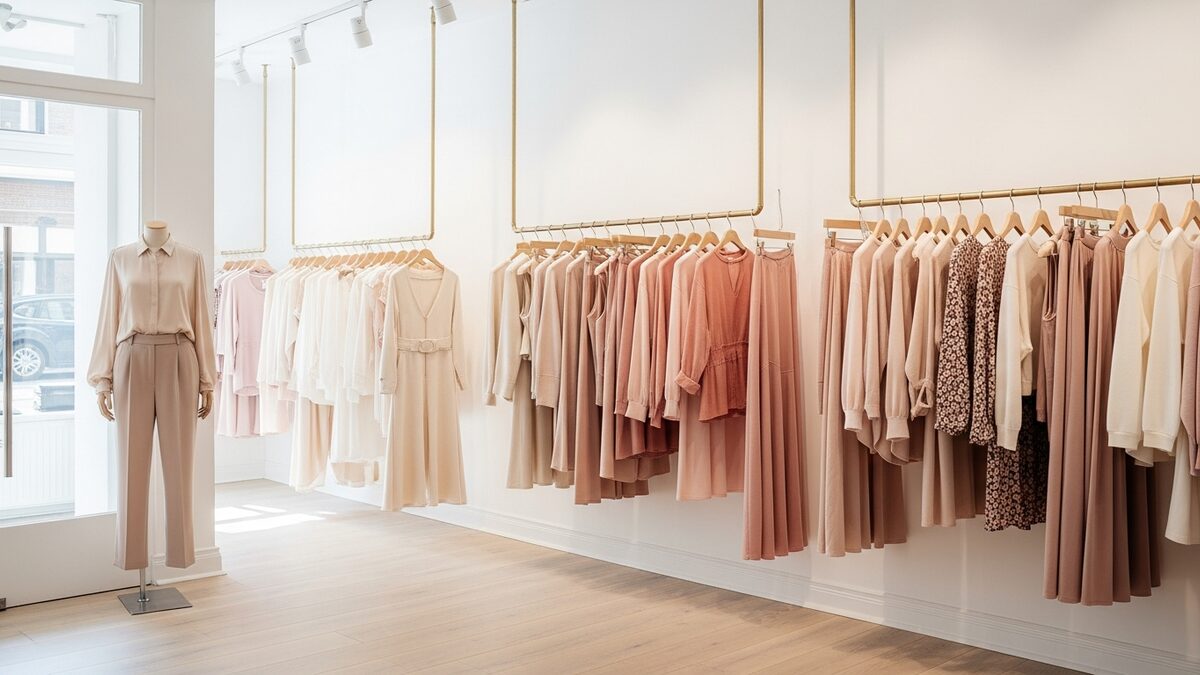
- Colour-blocking your rails — grouping pieces by tone rather than style — is the single fastest way to improve the visual appeal of a boutique shop floor.
- Boutiques that build and display complete outfits on a mannequin consistently sell more units per transaction than those showing separates alone.
- A front-facing hero piece at the entry point of a rail acts as an anchor that draws customers in and sets the commercial tone for the display.
- Rotating the front two pieces on each rail every seven to ten days gives returning customers a reason to look again and prevents visual fatigue.
- Irish boutique customers are more likely to ask about a piece they can see styled than one hanging without context.
Visual merchandising is the difference between a boutique that browsers walk through and one that buyers buy from. The way you display your stock — how rails are organised, what goes on the mannequin, where the eye lands when a customer walks in — affects sales more directly than most boutique owners realise.
The good news is that effective merchandising does not require a large budget or a professional stylist. It requires a few consistent principles, applied regularly.
What Is Visual Merchandising and Why Does It Matter for Boutiques?
Visual merchandising is the practice of arranging clothing, accessories, and displays to encourage customers to browse longer and buy more. In a fashion boutique, it means every decision about how stock is displayed on the shop floor — from rail layout and colour grouping to mannequin styling and the placement of key pieces.
Done well, visual merchandising reduces the need to actively sell. The shop floor communicates what the brand is about, surfaces the most commercial pieces, and makes it easy for a customer to see herself in the clothes. A well-merchandised boutique can increase average transaction value significantly without any change to the product itself.
Colour-Block Your Rails
The single most effective change most boutiques can make is to colour-block their rails — grouping pieces by colour family rather than by brand, style, or the order they arrived in.
A rail that mixes navy, burnt orange, ivory, and black randomly looks chaotic from a distance. A rail that moves from ivory through blush to dusty rose to berry looks considered, calm, and easy to shop. Customers are drawn to visual coherence. Chaos makes people move on.
To colour-block effectively:
- Anchor each rail with neutrals at one end — ivory, camel, or black work well depending on the season.
- Move through tones gradually — light to dark, or warm to cool — rather than placing contrasting colours beside each other randomly.
- Keep prints and patterns together rather than scattered along the rail.
- If a rail holds multiple brands, ignore the brand separation and group by colour regardless.
This applies to brands with strong colour stories like Black Colour and Rue de Femme, where the seasonal palette is part of the brand identity. Keeping their pieces together in a coherent colour run lets the collection speak clearly to the customer.
Build Outfits on the Rail, Not Just Individual Pieces
Customers who can see a complete outfit sell through faster than customers who have to imagine the combination themselves.
The most effective rail layouts include at least one or two full outfit suggestions built directly into the display — a top beside the bottom or skirt it works with, a jacket placed beside the dress it complements. This is sometimes called "cross-merchandising" and it consistently increases units per transaction.
A practical way to do this without disrupting a colour-blocked rail is to use a small side hook or nearby fixture to show the companion piece. The customer's eye goes to the main rail, but the outfit suggestion is immediately visible.
Use Your Mannequin as Your Best Salesperson
The mannequin closest to the entrance — or in the window — is one of the highest-value display positions in the boutique. It is often the first thing a customer sees and the piece that decides whether they walk in or walk past.
The most common mistake is placing the most dramatic or editorial piece on the mannequin. A stronger approach is to put your most commercial outfit there — the look that best represents what your current customer will actually buy, styled in a way she can immediately imagine wearing.
Effective mannequin styling means:
- A complete look — not just a dress or a top, but a full head-to-toe outfit including footwear or accessories where possible.
- Pieces that reflect the season and current deliveries — not old stock.
- A silhouette that flatters a range of body shapes, not one that only works on a sample size.
- A change every one to two weeks, regardless of whether the pieces have sold or not.
A static mannequin is a missed opportunity. Returning customers — your most loyal buyers — need a reason to look again every time they pass.
Front-Face Your Hero Pieces
Most boutique rails display clothes in profile — hangers showing the side of a garment, one behind the other. This is efficient for storage but passive for selling.
Front-facing a piece — turning the hanger so the garment faces the customer directly — dramatically increases its visibility. Even one or two front-faced pieces per rail can anchor the eye and pull a customer toward the display.
Choose your hero pieces carefully. The front-faced piece should be:
- A strong commercial piece, not necessarily the most expensive one.
- A piece with visual impact at a distance — good colour, interesting texture, or a confident silhouette.
- A piece with sufficient stock behind it, so selling it out doesn't leave a gap.
Keep Stock Levels Visible but Not Overwhelming
A packed rail can be difficult to shop. When garments are too tightly packed, customers cannot easily pull pieces out to look at them properly — and a boutique that is hard to browse loses sales.
A useful rule: if a customer cannot easily remove and replace a hanger on a rail without disturbing the pieces on either side, the rail is too full. Edit it regularly. Move slow-moving pieces to a back section or sale rail to keep the main floor fresh and easy to navigate.
For advice on which new pieces to introduce to keep your floor looking fresh, contact us directly or browse the current brand range — express drops from several brands are available for in-season top-ups.
Rotate Regularly to Reward Returning Customers
One of the simplest and most overlooked merchandising habits is regular rotation. Moving the front two pieces on a rail, repositioning a mannequin, or moving a fixture to a new spot in the store costs nothing — but it gives the shop a fresh feel.
Returning customers notice when nothing has changed. A customer who visits every few weeks and sees the same display in the same position begins to assume the stock is the same too. A boutique that looks different on each visit signals freshness, new arrivals, and a reason to browse properly.
Aim to make at least one visible change to the shop floor every seven to ten days. It does not need to be significant — a repositioned mannequin, a new front-faced hero piece, or a rail reorganised by tone is enough to make the space feel new.
Apply the Same Principles to Accessories
Accessories — particularly eyewear, jewellery, and scarves — are often merchandised as an afterthought in boutiques, placed near the till or in a small display unit. Repositioning accessories beside the clothing they complement increases sell-through significantly.
If you stock Otra Eyewear, for example, placing frames beside an outfit display on a neutral-toned rail gives the eyewear immediate context — the customer sees the look as a whole rather than considering the sunglasses in isolation.
See also: how to find reliable fashion wholesalers in Ireland for guidance on building a commercial brand mix that is easier to merchandise together. If you are based in Dublin and looking for wholesale buying options, our fashion wholesaler in Dublin page has more on how we work with boutiques. For brands looking to enter the Irish market, visit our fashion agency and distribution partner in Ireland page.
Summary: Merchandising Principles That Work
- Colour-block every rail — group by tone, not by brand or style.
- Build outfits on the rail using cross-merchandising to increase units per transaction.
- Put your most commercial, complete outfit on the mannequin — not your most dramatic piece.
- Front-face one or two hero pieces per rail to anchor the customer's eye.
- Keep rails from being overpacked — make the space easy to browse.
- Rotate and refresh the floor every seven to ten days to reward returning customers.
- Place accessories in context beside the clothing they complement.
Merchandising is an ongoing practice, not a one-time setup. A boutique that applies these principles consistently will consistently convert more browsers into buyers.
Frequently Asked Questions
- What is visual merchandising in a fashion boutique?
- Visual merchandising is the practice of arranging clothing, accessories, and displays to encourage customers to browse longer and buy more. In a fashion boutique, this means decisions about rail layout, colour grouping, mannequin styling, lighting, and the placement of hero pieces. Done well, it reduces the need to actively sell — the shop floor does the work.
- How do I colour-block my fashion boutique rails?
- Group pieces by colour family rather than by brand or style. Start with neutrals (ivory, black, camel) at one end and move through tones gradually — for example, ivory to blush to dusty rose to berry. Avoid mixing high-contrast colours randomly along a single rail. Each rail should feel visually resolved from a few metres away.
- What should I put on a mannequin in my boutique?
- Put your most commercial outfit — not your most dramatic piece — on the mannequin closest to the entrance. This should be a complete, wearable look: top, bottom or dress, and an accessory if relevant. It should represent what your customer will actually buy, styled in a way she can easily imagine wearing. Change it at least every two weeks.
- How often should I change my boutique window display?
- Window displays should change every two to three weeks at minimum. Returning customers — who are often your most loyal buyers — will stop noticing a window they have seen before. A fresh display, even a small change, signals that new stock has arrived and gives people a reason to come in.
Looking to Refresh Your Brand Mix?
Elevation Agencies works with independent Irish boutiques, supplying Scandinavian womenswear and accessories brands. Contact us to discuss new season arrivals and express drop availability.
Get in TouchBook a Brand Appointment
Want to discuss what might suit your boutique? Request a short brand appointment with Elevation Agencies.
Request an Appointment