
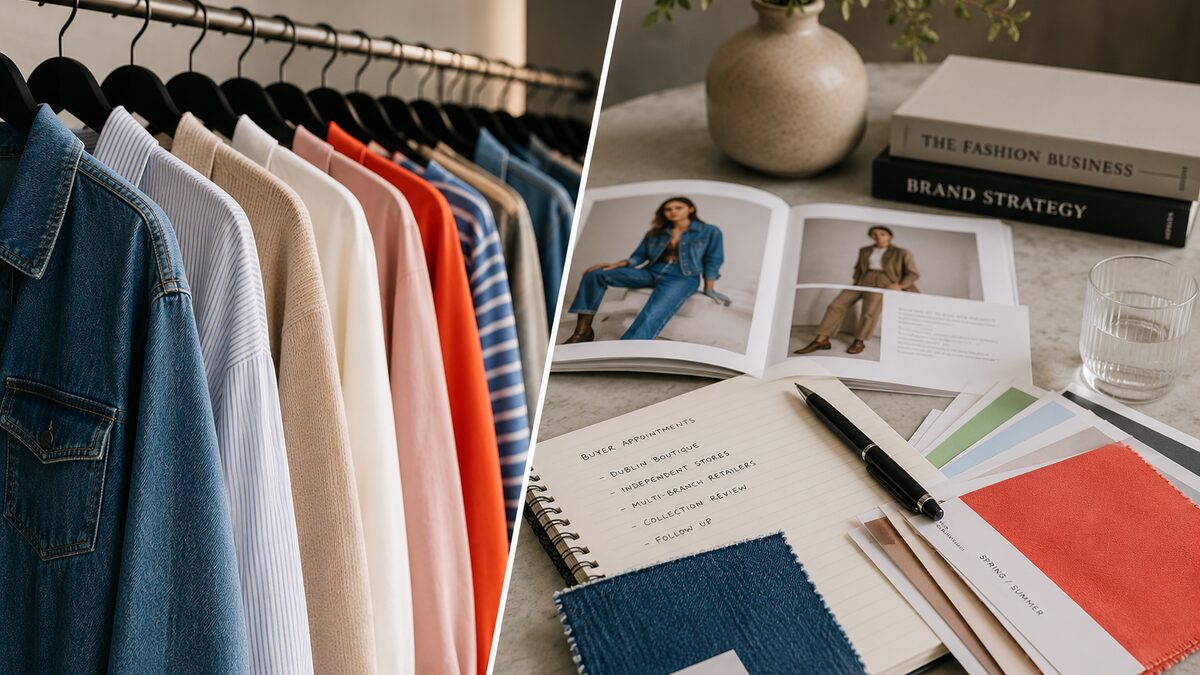
- A fashion agent represents your brand and earns commission — they introduce retailers, manage showroom appointments, and follow up buyers without owning stock.
- A fashion distributor takes a deeper commercial role, often buying or holding stock locally and managing wholesale supply to retailers.
- The right model depends on your brand's stock position, margin structure, and the type of Irish retail relationships you need to build.
- Ireland is relationship-led — independent boutiques are central, and the right local partner must understand boutique buying behaviour and limited rail space.
- Showroom presence in Dublin still matters — Irish buyers need to see fabric, fit, and finish in person before committing to a new brand.
- Structure supports relationships — a partner with a CRM and B2B system converts more opportunities than one relying on relationships alone.
For international fashion brands looking to enter Ireland, one of the first questions is often practical:
Do we need a fashion agent, a distributor, a wholesaler, or all three?
These terms are often used together, but they do not always mean the same thing. Understanding the difference matters because the right route into the Irish market depends on your brand, your product, your stock model, your pricing, and the type of retailers you want to reach.
For some brands, an Irish fashion agent is the right fit. For others, a distribution model may make more sense. In some cases, a brand may need a partner who understands both models and can help shape the right approach for Ireland.
The key point is this: entering Ireland is not just about finding someone to sell your collection. It is about finding the right local partner to represent your brand properly, introduce it to suitable retailers, and manage the market with structure and consistency.
What Is a Fashion Agent?
A fashion agent acts as the commercial representative for a brand in a specific market or territory.
In simple terms, the agent introduces the brand to retailers, presents collections, arranges showroom appointments, manages buyer conversations, supports orders, and helps build the brand's retail base.
A fashion agent usually does not own the stock. Instead, the agent represents the brand and earns commission on orders placed by retailers.
For international brands entering Ireland, a fashion agent can be valuable because they already understand the local retail landscape. They know which boutiques may be suitable, how buyers work, what price points feel realistic, and how to present the brand in a way that makes sense for the Irish market.
A good fashion agent should help with:
- Introducing the brand to suitable boutiques and retailers
- Presenting seasonal collections
- Arranging showroom appointments
- Explaining the brand story and product strengths
- Advising on product fit for the Irish market
- Managing buyer follow-up
- Supporting communication between the brand and retailers
- Building trust over time
In Ireland, where many fashion retailers are independent boutique owners, relationships matter. A fashion agent does not simply send a lookbook and wait for orders. They manage introductions, explain the product, answer questions, and keep the conversation moving.
What Is a Fashion Distributor?
A fashion distributor usually takes a deeper commercial role than an agent.
A distributor may buy stock from the brand, hold stock locally, manage wholesale sales, handle invoicing, supply retailers directly, manage logistics, and take more responsibility for how the product reaches the market.
A fashion distributor may be responsible for:
- Buying or holding stock
- Selling product to retailers
- Managing wholesale availability
- Handling local invoicing or trade processes
- Supporting logistics or delivery
- Managing retailer relationships
- Providing local market feedback
- Building brand presence in the territory
Distribution can be useful when a brand wants a stronger local stock position, faster availability, or a more hands-on commercial structure in the market. However, distribution also requires the right product, margin structure, stock planning, and commercial agreement. It is not always the right model for every brand.
What Is a Fashion Wholesaler?
A fashion wholesaler sells product directly to retailers, usually at wholesale prices. Some wholesalers sell from available stock. Others work through seasonal buying appointments or forward-order collections.
In fashion, the word "wholesaler" is sometimes used broadly. A boutique buyer may search for "fashion wholesaler Dublin" when they are really looking for a showroom, fashion agency, distributor, or trade supplier. That is why the terms can become confusing.
For Irish boutiques, the practical question is often: who can show me suitable brands and give me reliable trade access? For international brands, the question is slightly different: who can represent our brand properly and help us build the right retail base in Ireland?
Those two questions may lead to the same type of partner, but the relationship model behind the scenes can differ. See also: what makes a reliable fashion wholesaler in Ireland — a useful starting point for boutiques assessing trade partners.
Why the Difference Matters for Brands Entering Ireland
The difference between an agent and a distributor matters because it affects how your brand is represented, how orders are managed, and how risk is shared.
With an agency model, the brand usually remains responsible for stock, delivery, invoicing, and fulfilment, while the agent focuses on sales representation, showroom appointments, retailer introductions, and follow-up.
With a distribution model, the local distributor may take on more responsibility for stock, wholesale selling, retailer supply, and sometimes local market management.
Neither model is automatically better. The right choice depends on the brand.
- A new womenswear brand entering Ireland may benefit from agency representation first, especially if it wants to test the market, understand buyer reaction, and build relationships gradually.
- An accessories brand with available stock and repeatable product may suit a distribution model if there is a clear commercial structure and enough demand.
- A brand with strong seasonal collections may need showroom representation and structured buyer appointments.
- A brand with repeat stock or trade reorder potential may need a more developed B2B process.
The important thing is to match the model to the brand's real route to market. Read more about how we approach fashion agency and distribution in Ireland.
What Brands Should Ask Before Choosing a Model
Before choosing between an Irish fashion agent or distributor, a brand should ask several practical questions.
1. Do we need representation or local stockholding?
If the brand mainly needs showroom appointments, buyer introductions, market feedback, and order support, an agent may be the right fit. If the brand needs local stock, faster wholesale availability, or a deeper trade supply model, distribution may be more suitable.
2. Who owns the stock risk?
In an agency model, the brand usually keeps more control and stock responsibility. In a distribution model, the distributor may take on more stock responsibility, depending on the agreement. This affects pricing, margin, delivery, and commercial risk.
3. How important is showroom presentation?
For fashion brands, seeing product in person still matters. Irish boutique buyers often want to touch fabrics, assess fit, see colours properly, and understand how a collection sits together before committing. A showroom presence in Dublin can be valuable under either model.
4. Does the partner understand independent boutiques?
Ireland is heavily relationship-led. Independent boutiques remain central to the market. The right partner should understand boutique buying behaviour, limited rail space, seasonal timing, pricing sensitivity, and the importance of trust. Learn more about what Irish boutiques look for in a new fashion brand.
5. Can the partner follow up properly?
Many opportunities are lost because follow-up is weak. A buyer may be interested but busy. A strong Irish partner needs a structured follow-up process — a contact list alone is not enough.
Why Ireland Needs Local Interpretation
A brand can be successful in Denmark, France, Spain, Germany, the Netherlands, Canada, or the UK and still need careful positioning in Ireland. The Irish boutique market has its own rhythm.
Many boutiques are owner-operated. Buyers are close to their customers. Rail space is limited. New brands need to earn their place. Product has to be wearable, commercial, and relevant to the store's real customer.
This is why a good Irish fashion agent or distributor should provide honest feedback. They should be able to advise:
- Which part of the collection is strongest for Ireland
- Which boutiques are likely to suit the brand
- Whether the price point feels realistic
- Whether the product is commercial enough
- Whether the brand needs a gradual introduction
- How to position the collection to Irish buyers
This feedback can be more valuable than simply chasing orders. A local partner should help the brand enter the market properly, not just quickly.
Why Showroom Presence Still Matters
Digital lookbooks are useful, but they cannot replace the experience of seeing a collection in person. A showroom gives the brand a physical presence in the market. It also gives buyers confidence.
For Irish boutiques, a showroom appointment allows them to see fabric, fit, colour, and finish — to understand the collection properly, ask questions, compare pieces, discuss pricing and delivery, and decide where the brand could sit on the shop floor.
For international brands, a Fashion City, Dublin showroom presence can help make the brand feel more established and accessible in Ireland. This matters whether the brand is working through an agent or a distributor. The buyer still needs to see the product, understand the story, and trust the person representing it.
Why Structure Matters as Much as Relationships
Fashion distribution is still built on relationships, but relationships alone are not enough. A modern fashion agency or distribution partner needs systems.
Retailer conversations need to be tracked. Showroom appointments need to be managed. Follow-up needs to be consistent. Brand interest needs to be recorded. Product information needs to be communicated clearly. Without structure, opportunities can be missed.
At Elevation Agencies, we developed Elevation OS, our custom CRM and in-house B2B platform for managing fashion brand distribution in Ireland. Elevation OS helps us organise boutique relationships, showroom appointments, follow-up activity, customer history, brand communication, collection interest, and B2B trade processes.
For brands entering Ireland, this creates a more structured route into the market. It supports the relationship-led nature of fashion while making the process clearer and better organised.
How Elevation Agencies Works Across Agency and Distribution Models
Elevation Agencies is an Ireland-based fashion agency and distribution partner based at Fashion City, Dublin. Our role varies depending on the brand and the commercial structure.
We distribute OTRA and act as Irish fashion agent for selected womenswear brands including Rue de Femme, PBO / Philosophy Blues Original, Black Colour, Yumi London, Yoga Jeans and Bruuns Bazaar. This gives us practical experience across both agency and distribution models.
For some brands, the right approach is agency representation: showroom appointments, boutique introductions, buyer follow-up, and market feedback. For others, a distribution model may be more appropriate, depending on the product category, stock position, margin structure, and commercial opportunity.
The key is not forcing every brand into the same model. The right structure should reflect the brand, the product, and the Irish market.
Independent Boutiques First, With Selected Wider Retail Access
Independent boutiques remain central to the Irish fashion market. They are often the best starting point for international brands because they are close to their customers, highly curated, and able to introduce new brands in a personal way.
However, Ireland also has selected multi-branch retailers that may be relevant for the right brand. At Elevation Agencies, our core focus is independent boutiques. We also have access to selected multi-branch Irish retail opportunities where there is a suitable product and commercial fit.
A brand entering Ireland should not simply chase the widest possible distribution. It should build the right retail base.
Agent, Distributor, or Hybrid Partner?
For many brands, the real question is not simply "agent or distributor?" The better question is: what kind of local partner does the brand need to build a commercially sensible route into Ireland?
A fashion agent may be right when the brand needs representation, showroom appointments, buyer introductions, and market feedback. A distributor may be right when the brand needs a deeper local trade model, stock support, or wholesale supply structure. A hybrid agency and distribution partner may be right when the brand needs local relationships, showroom presence, structured follow-up, and flexibility around the commercial model.
For brands entering Ireland, this flexibility can be important. The Irish market is small enough that relationships matter, but serious enough that the structure behind those relationships also matters.
Questions Brands Should Ask a Potential Irish Partner
Before appointing an Irish fashion agent or distributor, brands should ask:
- Do they already have relationships with independent Irish boutiques? Existing relationships help open relevant conversations.
- Do they have a showroom presence? A showroom gives buyers confidence and allows the product to be presented properly.
- Do they understand the difference between agency and distribution? The partner should be clear about what role they are taking and what responsibilities sit with each side.
- Can they give honest feedback on product fit? A good partner should help you understand what is likely to work in Ireland.
- How do they manage follow-up? Ask whether they use a CRM, B2B system, or structured process to manage conversations and opportunities.
- Do they understand both boutiques and selected larger retail opportunities? Independent boutiques are central, but selected multi-branch Irish retail opportunities may also matter where the brand and product fit are right.
- Can they protect the brand's positioning? The goal should be relevant retail growth, not simply chasing every possible order.
Frequently Asked Questions
- What is the difference between a fashion agent and a fashion distributor in Ireland?
- A fashion agent represents a brand in a territory, introducing it to retailers, managing showroom appointments, and earning commission on orders placed — without owning stock. A fashion distributor takes a deeper commercial role, often buying or holding stock locally, selling wholesale to retailers, and managing more of the route-to-market process. The right model depends on the brand's commercial structure and what kind of local support it needs.
- Who owns the stock risk in an Irish fashion agency model?
- In an agency model, the brand usually retains responsibility for stock, delivery, and fulfilment. The agent focuses on sales representation, showroom appointments, retailer introductions, and follow-up. In a distribution model, the distributor may take on more stock responsibility, depending on the commercial agreement. This distinction affects pricing, margin, delivery timelines, and overall risk.
- Why does showroom presence still matter for fashion brands entering Ireland?
- Irish boutique buyers often want to touch fabrics, assess fit, see colours in person, and understand how a collection sits together before committing. A showroom presence — such as at Fashion City, Dublin — gives the brand a physical presence in the market and gives buyers confidence. Digital lookbooks are useful, but they cannot replace the experience of seeing a collection properly in a real buying environment.
- How important are independent boutiques when entering the Irish fashion market?
- Independent boutiques are central to the Irish fashion market. They are often the best starting point for international brands because they are close to their customers, highly curated, and able to introduce new brands in a personal way. Ireland also has selected multi-branch retailers, but independent boutiques should be the priority — they are where new fashion brands build their Irish reputation.
- What is a hybrid fashion agency and distribution partner?
- A hybrid partner understands and operates across both agency and distribution models, adapting the commercial structure to suit the brand's needs. For some brands they may act as a pure agent, managing showroom appointments and retailer introductions. For others, they may take on distribution responsibilities. This flexibility can be valuable for brands that do not fit neatly into one model.
- What questions should an international fashion brand ask before appointing an Irish agent or distributor?
- Key questions include: Do they already have relationships with independent Irish boutiques? Do they have a showroom presence? Do they understand both agency and distribution models? Can they give honest feedback on product fit for the Irish market? How do they manage follow-up — do they use a CRM or B2B system? Can they protect the brand's positioning and avoid chasing every order indiscriminately?
Considering Entering the Irish Fashion Market?
Elevation Agencies works with international fashion brands entering Ireland, offering showroom representation, boutique introductions, and structured follow-up from our base at Fashion City, Dublin. Contact us to discuss whether an agency or distribution model is the right fit for your brand.
Get in TouchBook a Brand Appointment
Want to discuss what might suit your boutique? Request a short brand appointment with Elevation Agencies.
Request an Appointment